In the startup world, one major goal is to be backed by venture capital firms. Of those venture capitalist firms, Y Combinator stands out due to its massive portfolio with major successes such as OpenAI, Stripe, Reddit, Airbnb, and Coinbase, as well as involvement from high-profile Silicon Valley celebrities such as Peter Thiel, Paul Graham, and Sam Altman. Even more exclusive is the unicorn status, a prestige given to startups with over a $1 billion valuation. Of the 5,000+ startups to ever be backed by YC, 80+ were able to achieve unicorn status.
Of those 80 or so elite, cream-of-the-crop startups, Starcloud did it the fastest.
How?
The Timing No One Saw
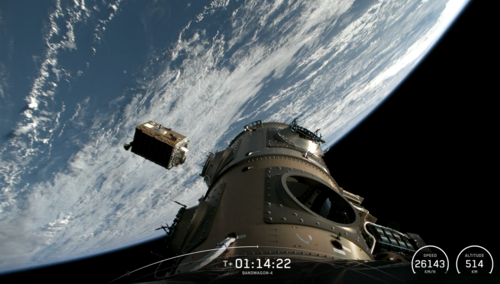
November 2025 marked a historic moment when a 60-kilogram satellite separated from a Falcon 9 and entered ito Earth orbit. A singular Nvidia H100 GPU powered on. The satellite that made it all happen was created entirely by a 15-person team led by CEO Philip Johnston, and under the price constraint of $3 million. By way of illustration, most commericial satellites cost north of $100 million, and the chip they launched alone costed the team at least $25,000.
Here on Earth, building a data center takes around 5 years, from obtaining permits and navigating power interconnections to determining grid capacities and completing construction.
AI has drastically increased the need for computing in a way that the cycle can no longer fully support. Data-center-dense markets like Northern Virginia and Dublin takes years to provide grid access alone.
The idea of building them in space and enjoying the endless solar energy and easier cooling isn’t so outrageous that no one else has thought of it. It’s just that no one thought the logistics were worth it, because everyone concluded orbital compute wasn’t ready.
Why they got funded
Benchmark General Partner Chetan Puttagunta led the $170 million series A, taking on a board seat along with it. His wager lies primarily in the fact that a 15-person team was able to solve the technical risks of getting hardware to work between -150°C to +120°C every 90 minutes, cooling through radiation instead of traditional convection methods found on Earth, and minimizing launch vibration so that it doesn’t destroy intricate components. On just $3 million.
The head start in technical know-how matters a lot, but the implied long-term wager is that Starcloud will be able to achieve so much that hyperscalers would not be able to catch up when they attempt to organize. CIA’s venture capital firm, In-Q-Tel, joined the $34 million seed funding because of the sovereign implications of orbital computing.
What’s Disruptive, what isn’t
Simply put, they’re the first to do it. Google’s similar mission, operation Suncatcher, is in early testing, and Elon’s always talked about doing something similar through SpaceX, but they’re in the FCC (Federal Communications Commission) filing phase. The operational lead they have on any competitor is almost impossible to close within two years.
However, their entire hardware is borrowed. SpaceX rockets and Nvidia chips alongside standard satellite components mean that, with enough time, money, and support from partners, other competitors wouldn’t have too much trouble replicating the technology.
Go-To-Market
Johnston took an action-first approach. Instead of pitching enterprise contacts as many would do in his place, he launched a satellite. That was enough to generate buzz from cloud providers, defense contractors, and research institutions.
The Blind Spot
Starcloud’s cost model closes when launch reaches roughly $500 per kg, and SpaceX’s vehicle, Starship, is the only one on the market that’s on track to get there. The company filed to deploy up to $1 million of its own data center satellites.
Starcloud is heavily dependent on SpaceX for infrastructure, and the company hasn’t made any commitments to pricing for third-party orbital customers. If Elon chooses to raise pricing, Starcloud may find it difficult to reach its cost-efficiency goals.
The Question
At what point does Philip Johnston feel that he needs a committed launch agreement with SpaceX or an alternative launch provider, before this risk becomes catastrophic?
The Takeaway
Johnston raised $200 million by spending 3, and he scaled it to $1.1 Billion. In deep tech, capital follows proof, not the other way around.